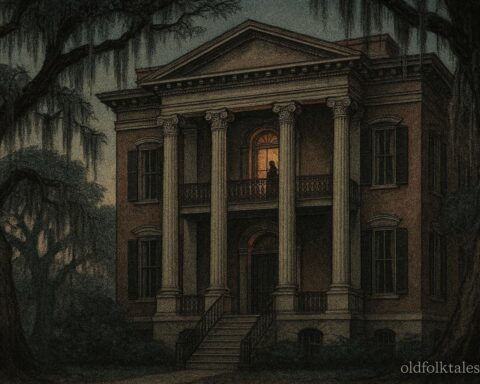
In the heart of Savannah, Georgia, where cobblestone streets wind past live oaks draped in Spanish moss, stands a stately brick house that once symbolized success, respectability, and Southern ambition. The Sorrel-Weed House was built in the mid nineteenth century by Francis Sorrel, a prosperous merchant whose wealth came from trade, shipping, and the expanding economy of the port city.
To the public eye, the house represented achievement. Its iron balconies, tall windows, and refined interiors reflected the aspirations of a man who had secured his place among Savannah’s elite. The home overlooked Wright Square, a place already steeped in earlier violence from colonial times, though such history was rarely discussed aloud.
Behind the elegant façade, however, the Sorrel-Weed House became the setting for personal tragedies that would slowly transform its legacy.
Encounter the strange and the unseen — from Bigfoot to regional monsters hiding in America’s forests.
Francis Sorrel married young, and his household expanded quickly with children and servants. Like many wealthy homes of the era, the Sorrel-Weed House operated on strict social hierarchies. Enslaved people and hired servants moved quietly through corridors and staircases designed to keep them unseen. Privacy, appearances, and control mattered deeply.
The first tragedy came with the death of Sorrel’s wife. Accounts differ, but folklore maintains that her passing was sudden and emotionally devastating. Some stories suggest illness, others hint at despair. What remains consistent is the belief that her death was not fully mourned, her grief unresolved within the walls she had once maintained.
Sorrel remarried not long after. His second wife was significantly younger, a detail that fueled gossip even during Sorrel’s lifetime. According to long-standing local lore, this young woman struggled within the household, isolated by social expectations and overshadowed by the memory of her predecessor.
The most haunting legend tied to the Sorrel-Weed House centers on her fate.
It is said that she was discovered hanging in an upstairs room, her death ruled a suicide by those eager to avoid scandal. Whether despair, fear, or deeper wrongdoing led to her end remains unknown. What folklore emphasizes is not the act itself, but the silence that followed. The household continued. The rooms were cleaned. Life resumed without reckoning.
Another story, darker still, speaks of an enslaved woman who worked within the home. According to oral tradition, she was subjected to abuse and ultimately fell or was pushed from an upper balcony, her death dismissed and forgotten by those in power. As with many such stories, no official records confirm her existence, yet the persistence of the legend reflects a broader truth about lives erased from written history.
The Sorrel-Weed House did not collapse under these tragedies. It endured, passing through generations and later becoming a public site. Yet those who entered the home reported sensations that went beyond historical curiosity.
Visitors spoke of sudden pressure in certain rooms, especially on the upper floors. Women in particular reported feelings of distress, dizziness, or sadness that arose without warning. Some claimed to hear footsteps pacing above them when no one else was present. Others described doors opening and closing softly, as if guided by unseen hands.
Staff members working in the house over the years became accustomed to unexplained occurrences. Lights flickered in rooms that had been rewired. Objects shifted slightly from where they had been placed. The house was never violent in its manifestations, but it was persistent.
One of the most frequently mentioned spaces is the former nursery. Guests standing there often describe a sense of heaviness, as though the room retained emotional weight. Some report the smell of perfume or flowers where none are present. Others experience an overwhelming urge to leave the room quickly, without knowing why.
The basement, once used for storage and service work, carries a different atmosphere. Visitors often note a sudden chill and a feeling of being watched. The space feels compressed, despite its open layout, a sensation that aligns with stories of suppressed suffering and unspoken cruelty.
Historians caution against accepting folklore as fact. Yet they also acknowledge that elite households of the nineteenth-century South were often sites of hidden violence, strict control, and emotional isolation. Wealth did not guarantee peace. Silence frequently replaced accountability.
The Sorrel-Weed House embodies this contradiction. It is beautiful, refined, and historically significant, yet burdened by stories of lives constrained and dismissed. Its haunting, like many domestic hauntings, is not loud or theatrical. It manifests as unease, repetition, and memory pressing forward.
Visitors rarely report seeing full apparitions. Instead, they feel presence. A sense that something remains unfinished. A sense that the house remembers what its occupants tried to forget.
In American haunted place folklore, such homes serve as warnings. They reveal how private suffering, when ignored, does not disappear. It settles into spaces. It lingers in architecture. It shapes how future generations experience a place.
Today, the Sorrel-Weed House stands as both a preserved historic home and a reminder of the emotional costs of power unchecked by compassion. Its walls still echo with stories not written in ledgers or letters, but carried forward through whispered accounts and shared experience.
The house does not accuse. It endures. And in doing so, it asks visitors to acknowledge the past rather than admire it blindly.
Click to explore all American Ghost Stories — haunting legends of spirits, lost souls, and mysterious places across the U.S.
Moral Lesson
When suffering is hidden and accountability avoided, the weight of unresolved guilt can linger far beyond a single lifetime.
Knowledge Check
- Who built the Sorrel-Weed House?
Answer: Francis Sorrel, a wealthy Savannah merchant. - What major theme is central to the house’s legend?
Answer: Unresolved guilt tied to domestic tragedy. - Why is the second wife’s death significant in folklore?
Answer: It represents hidden despair and silenced scandal. - Which areas of the house are most often associated with unease?
Answer: The upstairs rooms and the basement. - What type of haunting is most commonly reported?
Answer: Emotional and atmospheric disturbances rather than apparitions. - What does the Sorrel-Weed House symbolize in American folklore?
Answer: The consequences of ignored suffering within domestic spaces.
Source
Adapted from Georgia Historical Society folklore archives
Cultural Origin
19th-century Southern United States