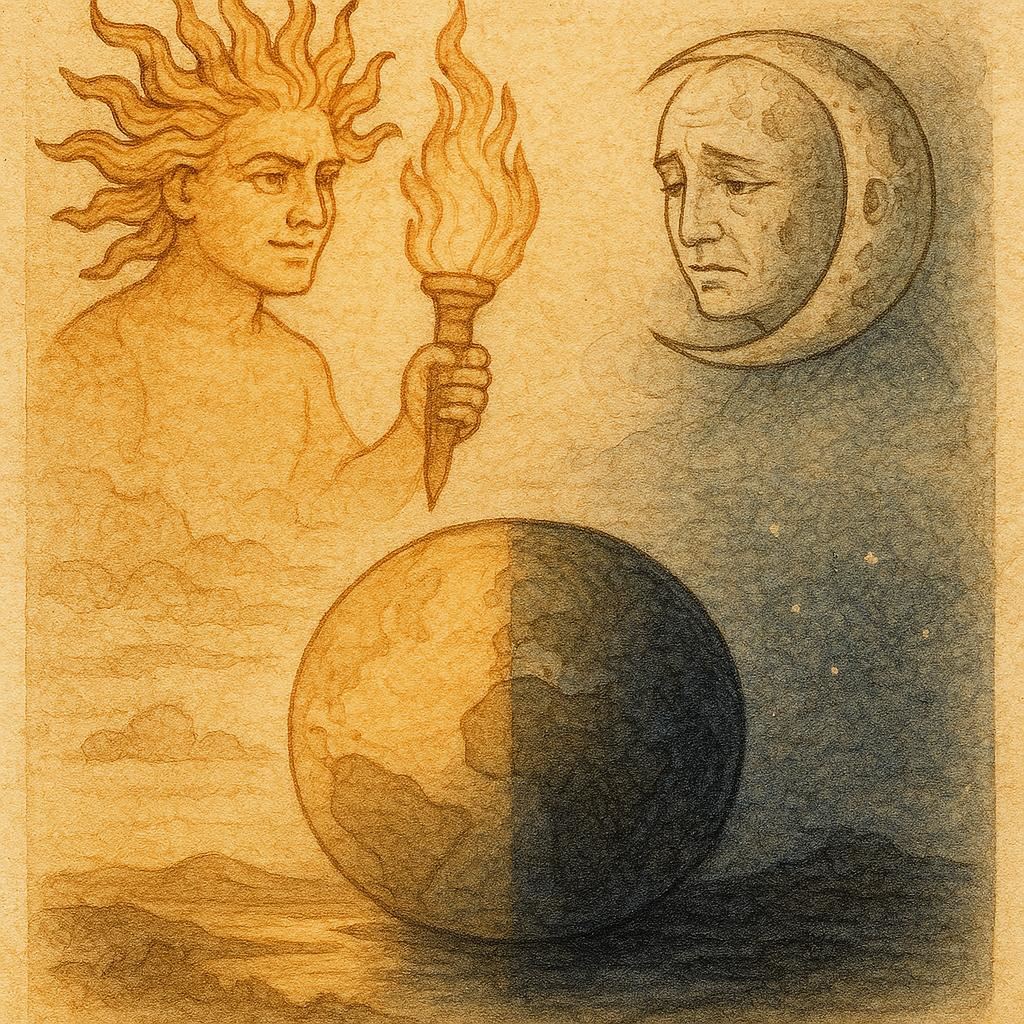
In the ancient days, before the world found its rhythm of day and night, the Sun and the Moon lived together on earth as husband and wife. They shared one lodge under the vast sky, their home surrounded by whispering trees and flowing rivers of silver light. The folktale of their union tells how love, though radiant, can be shadowed by jealousy, and how balance was born from their eternal chase.
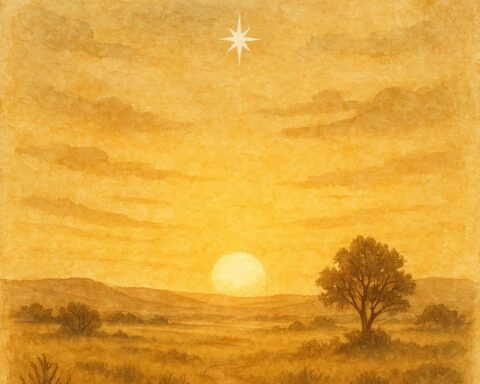
The Sun was radiant and strong, her golden light shining with a proud and fierce warmth. Wherever she walked, the forests glowed, the mountains sparkled, and all living beings turned their faces toward her in awe. Her laughter filled the skies, and her steps painted the world with life.
Click to read all American Traditions & Beliefs — the living folklore of daily life, customs, and superstitions.
The Moon, her husband, was gentle and quiet, his glow soft as a dream. While the Sun moved with fiery energy, he drifted with calm grace. At night, when he walked across the heavens, people gazed upon him with wonder. They admired his calm, silvery face and whispered praises for his beauty. The Sun began to notice this, and in her heart, a spark of jealousy flickered.
“Why do they look at him so tenderly?” she wondered. “Do they not see that I give them warmth and light?”
As the days passed, that spark grew into anger. The Sun loved her husband dearly, but envy clouded her heart like storm clouds across a summer sky. One evening, when the Moon returned from his gentle walk through the heavens, the Sun confronted him. Her light burned brighter than ever before, her eyes blazing with fury.
“You shine too softly,” she said, her voice trembling. “They love you more than they love me!”
The Moon tried to calm her. “My dear, their love for me does not lessen their love for you. Your warmth gives them life. My light only guides them through the darkness you leave behind.”
But the Sun’s rage could not be soothed. In a moment of anger, she struck the Moon with her burning torch. The flame scarred his face, leaving dark marks that still remain today. When she saw what she had done, sorrow filled her heart, but the damage could not be undone.
The Moon looked at her with sadness, his calm light flickering. “You have wounded me,” he said softly, “but I forgive you. Yet I can no longer live beside you. From this day on, we will share the same sky, but never the same path.”
With that, the Moon rose into the night sky, taking his place among the stars. The Sun, weeping, climbed to her own high path. From that day, they began their eternal dance, one chasing the other, but never quite touching. When the Sun’s golden chariot sets, the Moon’s silver face rises. Their paths meet only briefly, when the world darkens and time stands still, a moment we call an eclipse.
During these rare meetings, the Sun and Moon remember their love. They touch for an instant before parting again, each returning to their separate journey across the heavens. The people below watch in awe, reminded that love and distance can coexist, that even broken hearts can move in harmony.
The Sun continues to burn brightly, fierce and full of life, while the Moon glows gently, reflecting her light with peace. Their story, told by the Cherokee people for generations, teaches that even the greatest forces of nature must learn balance. Love, jealousy, and forgiveness share the same sky, just as the Sun and Moon share their eternal dance.
Moral of the Story
True love endures beyond anger and distance. Even when jealousy clouds the heart, forgiveness restores harmony and balance to all things.
Knowledge Check
-
Who are the main characters in this Cherokee folktale?
The Sun and the Moon, who were husband and wife. -
Why did the Sun become jealous of the Moon?
Because people admired the Moon’s beauty and calm light at night. -
What caused the scars on the Moon’s face?
The Sun struck him with her torch in anger, leaving dark marks. -
What does the eclipse represent in the story?
The brief reunion of the Sun and Moon, when they meet and remember their love. -
What lesson does the story teach about love and jealousy?
Love must be balanced with understanding, and jealousy can harm even the strongest bond. -
Where does this folktale originate from?
The Cherokee Nation in the southeastern United States.
Source: Adapted from Myths of the Cherokee by James Mooney, Bureau of American Ethnology (1900); and Native-Languages.org – “Cherokee Moon Legend.”
Cultural Origin: Cherokee Nation (Southeastern United States).