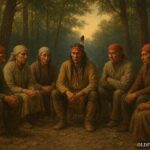
Water was never considered ordinary in the high valleys and plateaus where the people lived. Streams were watched, springs were named, and pools were approached with care. Water listened. Water remembered. Elders taught that it carried more than reflection. It carried intention. To approach it without honesty was to invite discomfort, if not consequence.
Among the many pools scattered through the foothills, one stood apart.
It rested in a shallow basin of stone, fed by underground seepage rather than visible flow. No animal tracks lingered near its edge for long. Birds drank quickly and moved on. Plants grew around it, but never over it. The surface remained unnaturally still, even when wind crossed the valley.
People called it many names, but most simply referred to it as the water that sees.
Step into shadowy legends of restless spirits and ghostly travelers in American Ghost Stories.
At first glance, it appeared like any other pool. Clear. Cold. Inviting on hot days. But those who knelt beside it noticed something unsettling. Faces did not always appear on its surface. Sometimes the water reflected the sky, the surrounding stone, even passing clouds. It did not always reflect the person leaning over it.
This absence was not random.
Children who approached out of curiosity saw themselves clearly. Hunters returning from honest labor saw their faces ripple back at them. Elders steady in purpose met their own gaze without distortion. But others those carrying concealed motives found the surface blank.
At first, the behavior of the pool became a curiosity.
People whispered about it during evening meals. Someone would mention kneeling by the water and seeing only stone and sky. Another would laugh it off. Reflection after all depended on light and angle. But patterns emerged. The same individuals repeatedly failed to see themselves, while others never experienced the phenomenon at all.
The elders listened.
They did not immediately explain the pool. Instead, they observed how people responded to it. Some laughed loudly and dismissed it. Others grew uneasy and avoided the area altogether. A few returned again and again, kneeling at different times of day, changing position, searching for their reflection as if it were something misplaced.
Over time, the pool became part of social awareness.
Those who spoke loudly about the pool were often the same ones whose reflections were absent. They accused the water of trickery. They accused others of exaggeration. Some even attempted to disturb the surface, throwing stones or stirring it with sticks, only to find that the water settled quickly, returning to its unnatural stillness.
One season, tension grew within the community.
Supplies went missing. Disputes arose over shared hunting grounds. Accusations circulated quietly, then openly. Each person suspected someone else, but no proof emerged. Voices hardened. Trust weakened. The elders recognized the familiar signs of imbalance.
They called a gathering near the pool.
The meeting was not announced as a judgment. No names were spoken. Instead, the elders spoke of intention. They reminded everyone that actions leave traces, even when hidden. They spoke of water as a witness, not an enforcer. Then they invited each person to approach the pool alone.
One by one, community members knelt at the waters edge.
Those who carried no concealed harm saw themselves reflected clearly. The water showed lines of age, fatigue, and worry. It showed them. Others saw only fragments. A shoulder. A shadow. A blurred outline. And some saw nothing at all. The surface held the sky but denied the face.
No elder commented.
The silence did the work.
Those without reflections felt exposed without being accused. The pool had spoken without words. People shifted uncomfortably not because they had been named but because they had been revealed to themselves.
One individual lingered longer than the others.
They had been central to recent disputes quick to accuse and eager to redirect suspicion. When they knelt the water remained empty. No face. No outline. Only the reflection of clouds moving slowly overhead.
They returned the next day. And the next.
Each time the water refused them.
Finally they approached an elder.
The elder did not ask questions. They did not offer judgment. They simply asked whether the person wished to be seen or wished to remain hidden. The distinction mattered. Wanting truth and wanting absolution were not the same.
That night the individual spoke publicly.
They admitted to withholding supplies to manipulating conversations to redirecting blame. The confession did not come easily. It was not dramatic. It was hesitant and incomplete at first. But as the words continued something shifted. The weight carried silently for weeks began to loosen.
The following morning they returned to the pool.
This time the water reflected their face.
Not unchanged. Tired. Strained. Marked by shame. But visible.
The story spread not as a warning but as understanding.
The pool did not punish. It did not accuse. It did not expose wrongdoing to others. It simply refused to cooperate with self deception. Reflection was not a right. It was a response.
From then on people approached the water with intention.
Before kneeling they asked themselves what they carried. Before speaking near it they measured their words. The pool became a place not of fear but of alignment. Those uncertain of their motives avoided it not because they were forbidden but because they were not ready.
Children learned its lesson early.
They were told that if they ever failed to see themselves it did not mean they were lost. It meant something was being hidden. And what was hidden could be brought into the open if one chose honesty over comfort.
Over generations the pool remained.
It never reflected everyone. It never stopped reflecting those who approached in truth. And it never explained itself. It did not need to.
The water continued to hold the sky.
But it showed faces only to those willing to face themselves.
Click to read all American Folktales — timeless oral stories passed through generations across the United States.
Moral Lesson
Honesty with oneself is the first step to justice. Truth cannot be forced but must be approached willingly. Self-recognition and accountability begin with intention.
Knowledge Check
- Why was water considered significant in the community?
Answer: It was believed to listen, remember, and respond to intention - What made the pool unusual?
Answer: It refused to reflect the faces of those hiding harmful intent - How did elders respond to the pool’s behavior?
Answer: They observed patterns rather than immediately explaining - Why did the pool not accuse anyone directly?
Answer: Its purpose was self-recognition, not public judgment - What allowed reflections to return?
Answer: Honest acknowledgment of hidden actions - What lesson did children learn from the pool?
Answer: That clarity requires honesty and self-awareness
Source
Adapted from University of Colorado Indigenous ethical folklore documentation
Cultural Origin
Ute communities