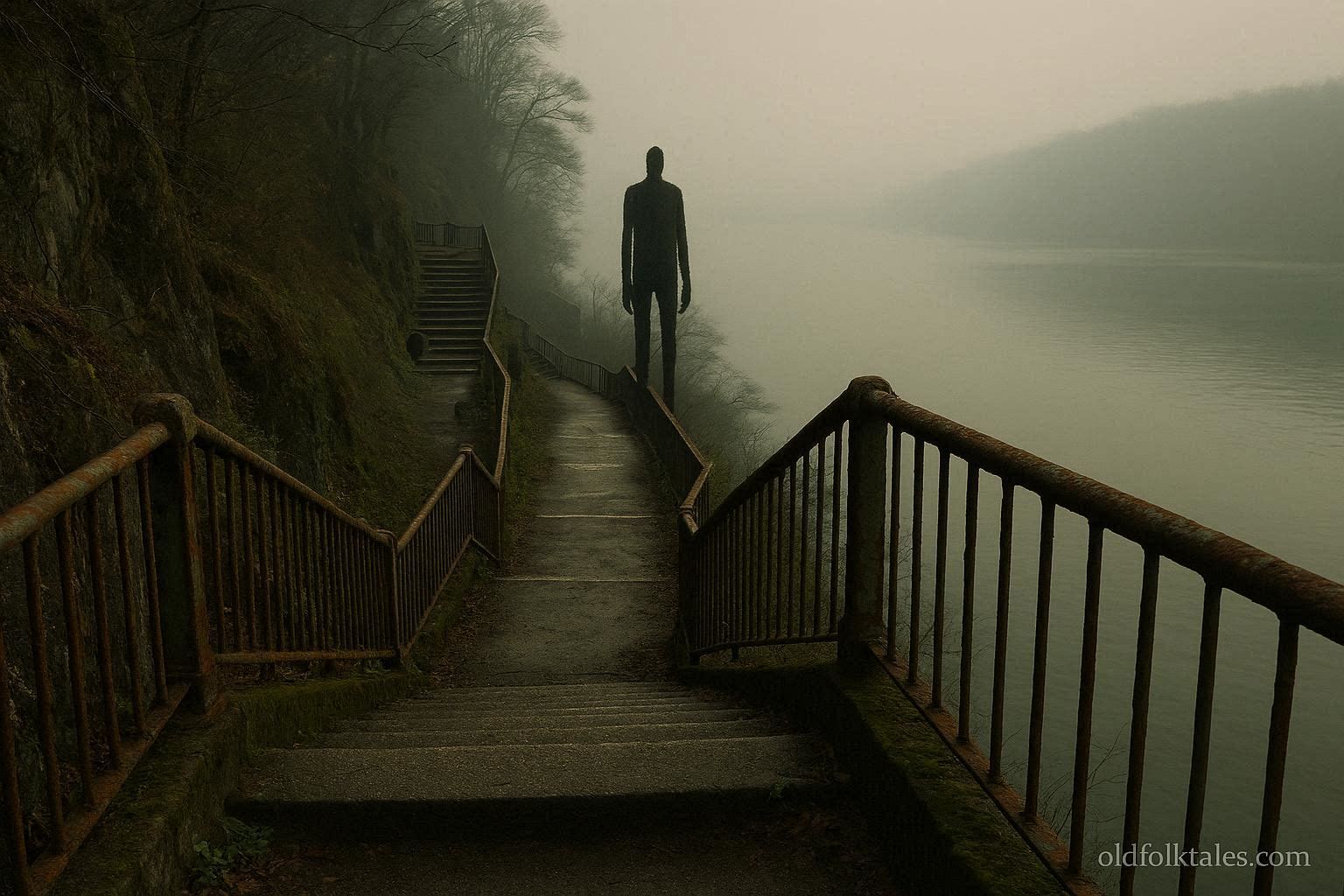
The cliffs along the Hudson River rise like ancient walls above the water, their sheer faces carved over millennia. Between these cliffs, old staircases wind upward, remnants of footpaths that once connected ferry points, small homes, and scenic lookouts. Most of these staircases have long since been abandoned. Rust eats the railings, moss cracks the stone, and weather smooths each step into uneven surfaces. Yet even in their silence, these staircases hold a peculiar presence.
Locals first spoke of the figure decades ago. Hikers, joggers, and urban explorers began reporting a tall humanoid standing motionless on the steps. Its posture was always upright, shoulders squared, head slightly tilted as if scanning the river below. It never moved when approached, yet when witnesses looked away and then glanced back, it sometimes appeared higher or lower on the staircase, as if it had shifted without a step.
Descriptions vary slightly, but most agree on its size and shape. The figure is taller than an average human. Limbs are long and thin, yet proportioned. No facial details are ever discernible. It wears no clothing recognizable to modern eyes. Its form blends subtly with shadow and cliffside moss, giving the impression of something between material and apparition.
Explore ancient Native American creation myths and the symbolic tales that shaped America’s belief systems.
Witnesses report the feeling first, even before they see it. A shiver, a sense of being watched, a sudden awareness of how exposed the staircase feels. Then the figure appears in a spot just beyond their immediate reach. It does not threaten. It does not wave or beckon. It simply watches.
One hiker described climbing the staircase on a misty morning. As the fog swirled around the cliff, she noticed the silhouette leaning against a railing far above. She froze. The figure did not move. She froze longer than necessary, then stepped carefully past it, turning briefly to glance back. The figure was gone. She had been certain it had remained in place, yet no one else was nearby.
The Palisades Staircase Figure appears primarily in early morning or twilight hours. Light is crucial; direct sunlight seems to dissipate the effect, while dim illumination makes it more tangible. This has led folklorists to suggest that it is tied to perception, shadow, and human attention. Yet multiple independent accounts over decades suggest that witnesses often see it under conditions where shadow alone cannot explain its consistent form and posture.
Urban folklore researchers note a common thread in such cliffside cryptids. They are often associated with surveillance, as if standing guard over spaces that once served vital functions. The abandoned staircases were not mere leisure paths. They were conduits of movement, work, and community. When those functions ended, the stories suggest, the space retained a watchful presence.
The figure’s persistence has created local lore. Some call it a sentinel. Others speak of it as a spirit of the cliffs, reminding visitors that nature, though silent, monitors human intrusion. Hikers are warned not to linger unnecessarily or to try to climb past the figure aggressively. Those who respect the space and move deliberately report seeing the figure less frequently. Those who rush or make noise often notice it appearing closer than expected.
The Palisades Staircase Figure does not interact directly with humans. It does not cause harm. Its function seems observational. In some accounts, the figure subtly shifts when multiple people are present, almost as if it prefers solitude or precise conditions. Some researchers suggest this may reflect collective human memory of the area rather than a physical entity, yet the figure’s consistency over decades defies simple explanation.
The psychological impact of the figure is significant. Witnesses describe unease, heightened awareness, and a strange respect for the staircases themselves. It encourages care, attentiveness, and acknowledgement of the history embedded in the cliffside. It does not punish, but its presence compels humans to recognize the space as more than a path.
Some speculate the figure represents the collective energy of workers, travelers, and residents who once used the staircases daily. Others see it as a product of human perception, amplified in liminal spaces where the environment feels alive. The Hudson River cliffs, steep and echoing, are prime locations for such phenomena. The figure may be a cryptid, a ghost, or something in between, but it has become a fixture of local folklore, a story passed from hikers to students, tourists to historians.
Accounts often end with the same note. The figure disappears, often suddenly, leaving no trace. It does not follow the witnesses into town. It does not leave the cliffside. It exists entirely within the abandoned staircases. It belongs to the steps, the moss, and the echo of movement long ended.
The Palisades Staircase Figure is more than a tale of fear. It is a reminder of observation, respect, and the lingering presence of spaces once alive with human purpose. The cliffs may endure for centuries, and the figure, whether imagined or real, endures with them.
Click to read all American Cryptids & Monsters — creatures of mystery and fear said to inhabit America’s wild landscapes.
Moral Lesson
Abandoned spaces remember the footsteps of those who came before. Respect and attention honor history more than haste or disregard.
Knowledge Check
1. Where is the Palisades Staircase Figure most often seen?
On abandoned staircases carved into the Hudson River cliffs.
2. How does the figure behave when approached?
It remains motionless and upright, watching silently.
3. What times of day is it most commonly observed?
Early morning and twilight hours.
4. Does the figure interact directly with humans?
No, it does not approach or cause harm.
5. What effect does sunlight have on the figure?
Direct sunlight seems to make it less tangible.
6. How do witnesses describe their feelings around the figure?
Unease, heightened awareness, and respect for the staircases.
Source
Adapted from Columbia University urban folklore and landscape studies archives.
Cultural Origin
Hudson River Valley communities of the Northeastern United States.